I arrived in Guangzhou on February 12, just before Valentine’s Day, and being reunited with Emily after six weeks apart felt like the end of a held breath. We had done what couples do now—FaceTime, quick messages, little digital check-ins that function like brushing someone’s hand in a crowded room. Somewhere in the middle of that, I started a ritual: a daily love note with a song attached, usually something I’d been listening to in the shower. (If you want the most honest soundtrack of a person’s day, it’s probably in the room with the worst lighting and the best acoustics.)
The drive into the city surprised me in a way I didn’t expect. The familiar smells were there, yes—Guangzhou has a sensory signature I don’t think I’ll ever lose—but what stood out most was the green. Guangzhou doesn’t do winter the way my body expects winter to behave. Things keep growing. Even before spring brings the flowers that become so central to Chinese New Year—flower streets, family purchases, celebratory blooms—the city already looks alive.
With the New Year approaching, there was visible “manicuring” happening: plants tended, streets prepped, a subtle sense of readiness. After a long flight and a transfer in Hong Kong, that calm greenery felt like a kind of welcome.
Then the season shifted into its annual gravitational pull. Lunar New Year arrived quickly and, as it always does, reorganized priorities without asking permission. This year welcomed the Year of the Horse, and the preparations were evident everywhere. The first night of the 15-day celebration, fireworks erupted around us—sharp light and thunder in every direction—followed by family dinners stacked one after another.
I enjoyed it in every possible way. Not just the food, but the belonging. Meals are how this family measures time: not with minutes, but with dishes; not with efficiency, but with presence.
And yet, even in the brightness, there was a quiet absence.
One aunt had recently passed away after time in intensive care, and as tradition requires, that wing of the family could not participate in the celebrations while they mourned. The effect was larger than I would have predicted. The family chats—normally playful, full of jokes and those WeChat red envelopes that send a few yuan back and forth like confetti—went still. People avoided the streams, careful not to let cheerfulness collide with grief.
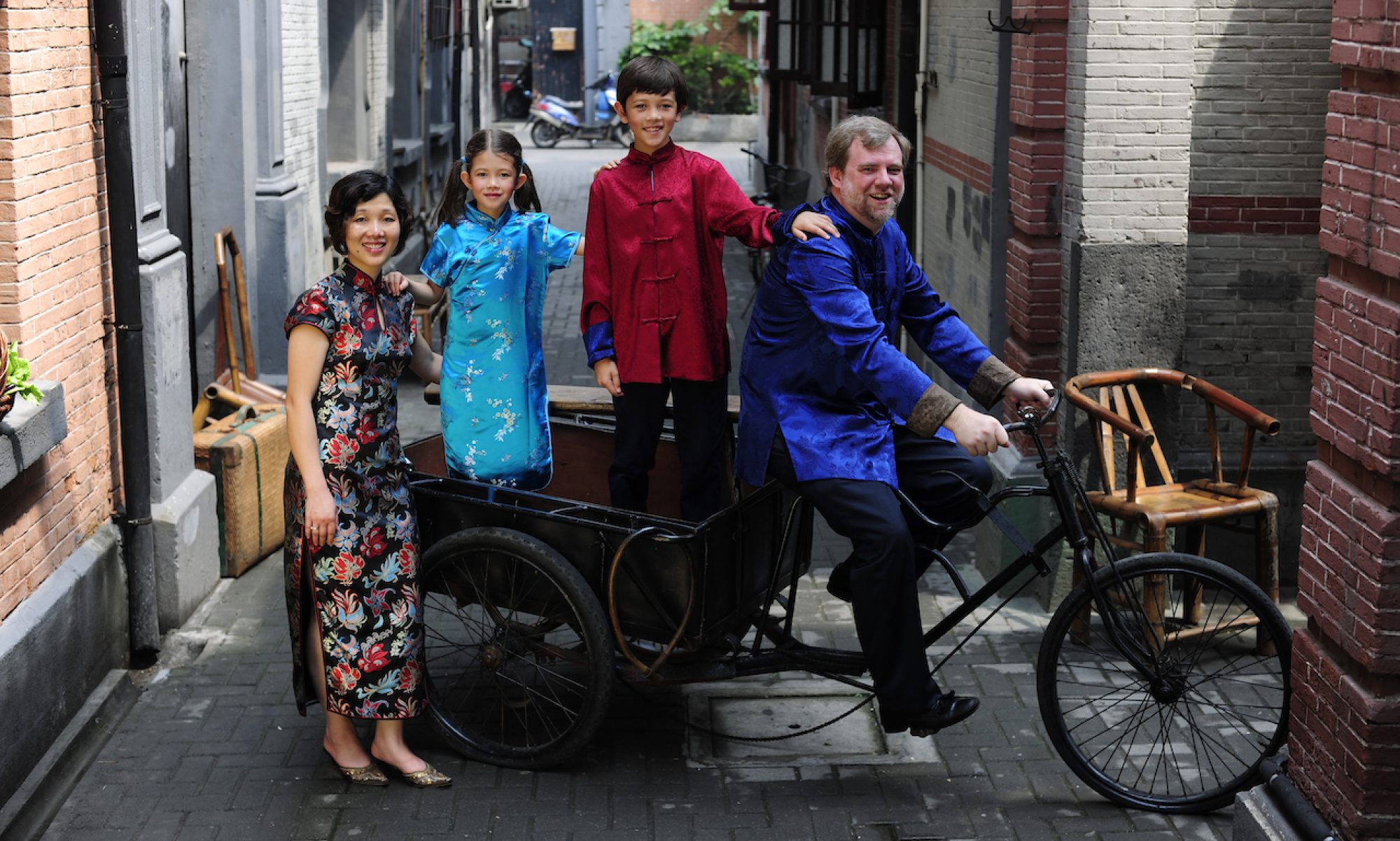
Some of my favorite people are on that side of the family, including two cousins who were the life of our Chinese wedding back in 1996. They bartered theatrically for my wife’s hand and ran the wedding games with the kind of joyful mischief you can’t manufacture. Their absence pulled my mind toward another truth: close family connection is precious, and it can thin quietly over time—not necessarily from conflict, but from distance, time zones, missed seasons. It’s not unlike what I’ve felt with my own family back home.
Meanwhile, Guangzhou continues to develop in ways that are hard not to notice. It feels cleaner and more walkable than I remember, healthier in the air and rhythm, while still retaining the charm of open fresh-food markets alongside modern grocery stores. The city manages to hold both: tradition and convenience, old texture and new systems.
And the systems are striking.
Everything has gone electric. Scooters are electric. Bicycles are rentable from the street with a QR code and cost only a few yuan for a long ride. A large share of the traffic is now electric vehicles, in all brands and varieties. And cash? I haven’t used it once. Everything is a scan. Street merchants do it too: you pick apples or flowers fresh from the farm, they point to a QR code hanging from an umbrella, you scan it, type the price, they receive a notification, and you’re on your way.
Watching this, it’s hard not to zoom out. In many places, daily life feels increasingly strained—politically, socially, emotionally. As we all watch war erupt in the Middle East and the constant din of catastrophe arrive on schedule, I find myself thinking about how much we all need a break from the noise—not to stop caring, but to stop being consumed by it.
Guangzhou, for me, will be an oasis for a while. Not an escape. A different posture. A chance to experience peacefulness and see what it teaches.
On the home front, Emily is working as a long-term substitute teacher at the American International School of Guangzhou, and I’ve stepped into a new role: house husband. I’m slowly taking over more of the cooking and cleaning. I’ve found ingredients for chocolate chip cookies and made a batch (small victory, big morale), cooked shrimp scampi and fried chicken, and we hosted a family meal in our apartment—Emily’s mom (PahPah), her brother Joe (Wei Bin), his wife AhFei, and our twin nephews, David and Andy.
We mixed Western and Eastern dishes—BBQ chicken wings, black rice, potatoes seasoned with olive oil and spices—an edible reflection of the life Emily and I have built: two cultures at one table, not competing, just coexisting.
We’re here partly to help care for PahPah, keeping that part of the story light and respectful because care isn’t a spectacle. But I will say this: a small bridge opened that I didn’t expect. Using translation mode in Cantonese, I had the closest thing I’ve ever had to a direct conversation with her, without Emily needing to translate. Yesterday I told her I could come spend the day with her while Emily is working, and she perked up at the idea.
A word came to mind that fits this season better than most:
陪 (péi) — to accompany.
Not to fix. Not to solve. To be there.
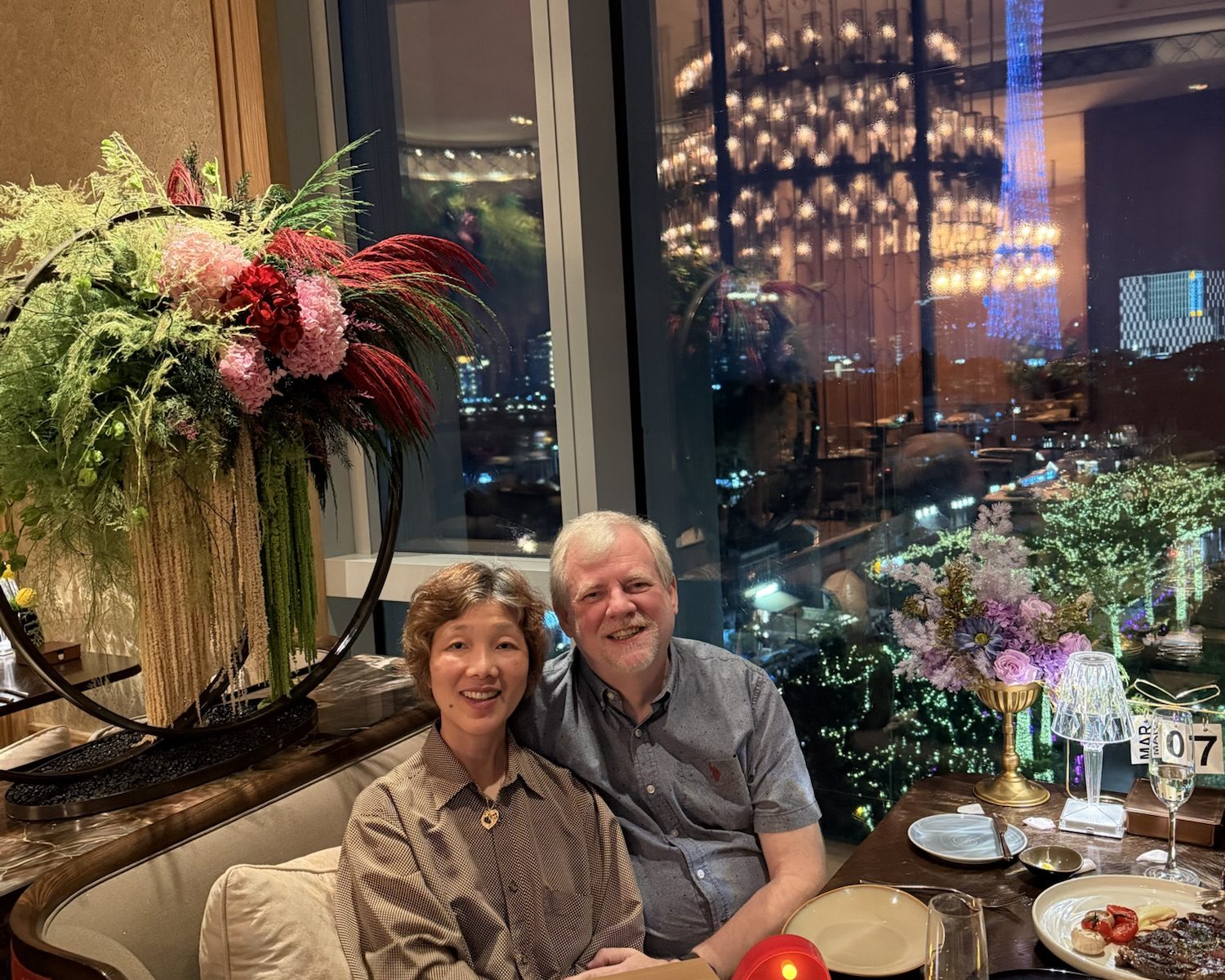
And then, as if the calendar wanted to tie everything together, Emily and I celebrated 30 years on March 8—the same date as our Chinese wedding day: March 8, 1996, over 200 guests back then, split between family and school acquaintances. This year we ditched the crowds and did just the two of us: a romantic meal at the Conrad Hotel, then a walk back across the Canton Tower pedestrian bridge, followed by a waterfront walk home.
Thirty years later, love looks less like a grand event and more like the quiet work of daily commitment. Showing up. Feeding people. Crossing bridges—sometimes literally. And learning, again, that peacefulness isn’t passive; it can be a path to insight.